Don't Send Raw LLM Output to Coworkers
Pasting the model’s first draft into Slack, email, or a ticket feels fast. For the person who receives it, the work often just moved sideways.
Don't send raw LLM output to coworkers is a collaboration rule, not an anti-AI rule. Use the model to draft. Share only what you have reviewed, rewritten, and are willing to stand behind.
This guide gives a practical workflow: spot raw AI text, run a short pre-share checklist, rewrite into accountable workplace writing, and set team norms that keep AI helpful without dumping cleanup on others.
What “raw LLM output” looks like at work
Raw output is text that still reads like a generic model response rather than a message from a colleague who owns the next step.
Common shapes:
Other tells:
- Perfect symmetry and filler transitions (“It is important to note…”, “In today’s fast-paced…”)
- Claims without owners, dates, links, or confidence level
- Advice that ignores your team’s tools, customers, or constraints
- A missing decision, deadline, or single next action
- Tone that does not match how your team actually writes
If a coworker would need a second pass just to understand what you want, the draft is still raw.
Why dumping raw AI text onto colleagues fails
1. It shifts cognitive load downstream
The generator spent seconds. The reader spends attention decoding structure, stripping filler, and recovering the real question. One “quick paste” multiplies cost across every recipient in the thread.
2. Context is missing even when the prose sounds complete
Models invent coherent-sounding structure around incomplete prompts. Coworkers still need audience, constraints, prior decisions, and what “done” means. Fluent text can hide those gaps.
3. Factual risk becomes shared risk
Unverified names, numbers, policy interpretations, or “sources” travel farther once they land in a team channel. If you did not check a claim, you transferred verification work—and blame risk—to someone else.
4. Ownership gets blurry
Raw paste answers “what did a model say?” Workplace writing needs “what do I recommend, what did I check, and what am I asking you to do?” Without ownership, people hesitate to act or challenge the content.
5. Tone and trust erode
Colleagues notice when messages stop sounding like the sender. Over time, AI-shaped handoffs train people to distrust updates, re-check everything, or ignore long messages entirely.
The core etiquette is simple: edit AI generated text before sharing. Review is part of the work product, not optional polish.
Pre-share checklist (use before every send)
Run this checklist in order. If any item fails, rewrite before sharing.
1. Goal
- What should change after someone reads this?
- Can you state the goal in one sentence without model filler?
2. Audience
- Who is the primary reader?
- What do they already know, and what must they not have to reverse-engineer?
3. Claims
- Which statements are facts, inferences, or opinions?
- Which claims did you personally verify?
- Mark uncertainty instead of smoothing it over.
4. Sources and evidence
- Where did key numbers, quotes, or policy points come from?
- Are links, ticket IDs, doc titles, or owners attached?
- Remove anything you cannot defend in a meeting.
5. Tone
- Does this sound like a competent teammate, not a generic assistant?
- Is the length matched to the channel (chat short, doc structured)?
6. Ask
- What is the single next action?
- Who owns it, and by when?
- If no action is needed, say “FYI only” and why it matters.
Completion standard: you can send when a busy coworker can answer four questions in under a minute—what is this, why now, what is true, what do you need from me?—without rereading the model’s scaffolding.
How to rewrite AI drafts into accountable workplace writing
Use this rewrite loop every time you review ChatGPT output before sending (or any other model).
Step 1 — Separate draft from delivery
Keep the model output in a private scratch space. The shared channel gets only your edited version. Never forward the raw completion “for convenience.”
Step 2 — Cut to the reader’s job
Delete throat-clearing, repeated definitions, and symmetric pros/cons that do not change the decision. Lead with the point:
- Decision or recommendation
- Why it matters now
- Evidence you checked
- Options considered (only if needed)
- Ask / deadline / owner
Step 3 — Re-attach human context the model cannot know
Add the details only you have:
- Prior thread or meeting decision
- Customer, codepath, market, or legal constraint
- What you already tried
- What is explicitly out of scope
Step 4 — Verify before you polish
Fact-check names, dates, metrics, and policy language first. Stylistic cleanup second. A smooth wrong message is worse than a rough correct one.
Step 5 — Put your name on the judgment
Replace “It could be beneficial to…” with “I recommend… because…”. If the model suggested options, state which one you support and what would change your mind.
Step 6 — Match the channel
- Chat: 3–8 lines, one ask, links below
- Email: subject that states the outcome; short top summary; details after
- Doc: decision at the top; background later
- Ticket: repro, expected vs actual, scope, logs/links—not an essay
Before / after pattern
Before (raw):
“In today’s workplace, effective communication is essential. Below is a comprehensive overview of potential approaches to improving the onboarding workflow, including several best practices and considerations for stakeholders…”
After (shareable):
“Recommend we pilot a 5-message onboarding sequence for new trial users starting Monday. I checked last month’s drop-off: most churn happens before the second login. Need design review by Thursday—can you own screens 1–2?”
Same underlying idea. Different amount of work imposed on the reader.
Good vs bad AI-assisted handoffs
Bad handoff
- Pastes a long model answer into a group channel
- No summary, owner, or deadline
- Includes unverified claims
- Ends with “thoughts?” without a decision frame
- Expects others to extract the action
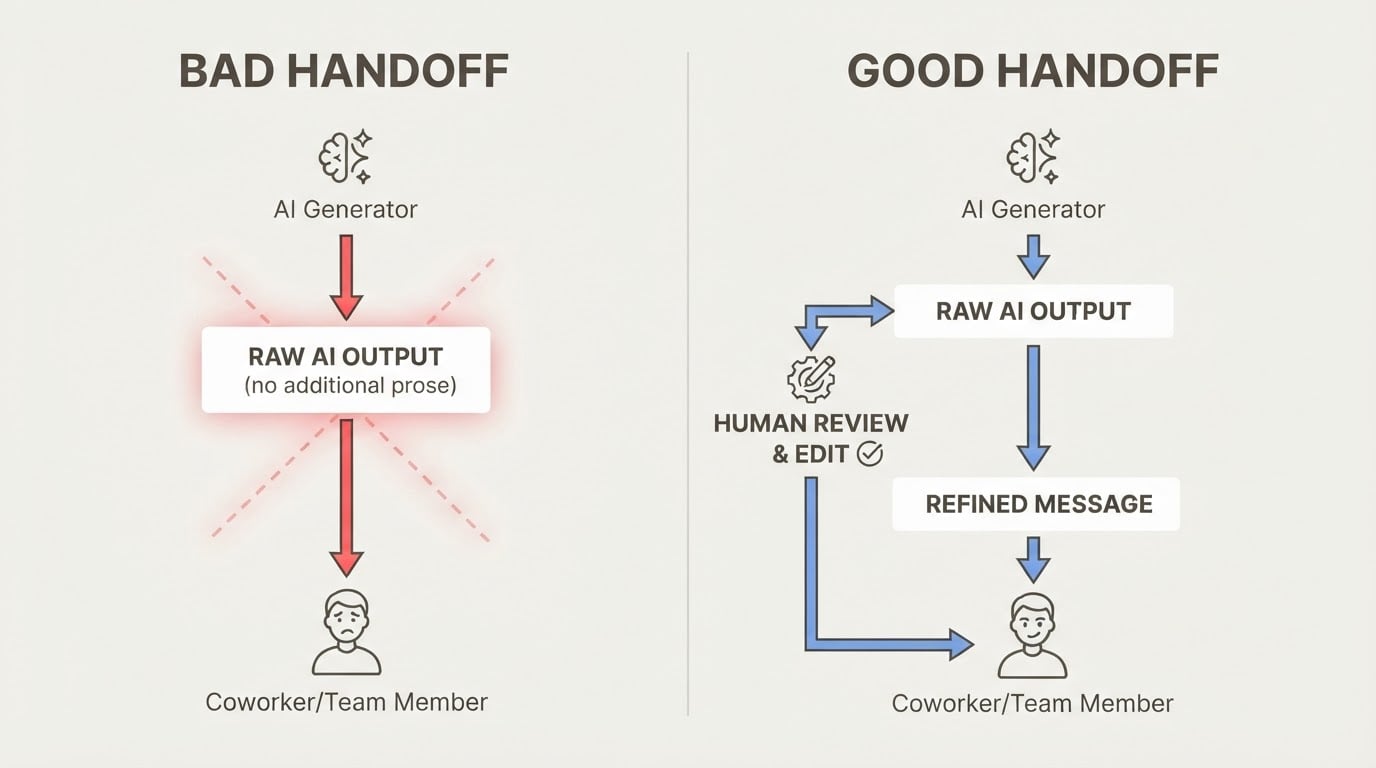
Good handoff
- Uses AI privately for outline, alternatives, or wording options
- Sends a short human message with context and a clear ask
- Labels uncertainty (“unverified—need legal pass”)
- Links source material instead of restating it poorly
- Accepts responsibility for the recommendation
Team norms that scale
Write norms as defaults, not slogans:
- Private draft, public edit. Models stay in personal scratch space until a human rewrite exists.
- No raw paste in shared channels. If someone needs the model text, share it as an attachment labeled “unreviewed draft,” not as the message body.
- Minimum header on AI-assisted work. Goal · Audience · Verified claims · Ask.
- Uncertainty must be visible. Guessed figures, speculative causes, and unconfirmed policy reads get explicit labels.
- Review time is real work. Budget minutes to edit. A two-minute rewrite often saves a twenty-minute thread.
- Managers model the behavior. If leaders paste raw output, the team will too.
- Retrospective the failures. When a raw paste causes thrash, capture what checklist item was skipped.
Workplace AI writing etiquette is less about banning tools and more about refusing to export cleanup work.
A 10-minute workflow you can repeat
Use this when the stakes are ordinary team coordination.
- Prompt for a draft with audience, goal, and constraints in the prompt (2 min).
- Extract only usable pieces—bullets, phrases, structure—not the whole voice (1 min).
- Run the six-point checklist and delete anything unchecked (3 min).
- Rewrite the top so the first screen answers what / why / ask (2 min).
- Send, then watch for confusion. If people ask basic clarifying questions, your checklist missed something; fix the template next time (2 min).
Done means: the message is short enough for the channel, every hard claim is verified or labeled, and a teammate can act without cleaning your draft.
Limitations
- This workflow does not replace legal, security, or compliance review for regulated content.
- High-stakes external statements still need the normal approval path even after a clean rewrite.
- Different teams tolerate different levels of informality; tighten the checklist for exec, customer, or public channels.
- If your prompt was wrong, editing style will not fix missing substance—restart with better inputs.
Quick reference
Do
- Draft with AI; deliver as a human owner
- Put the ask first
- Verify before you share
- Label uncertainty
- Keep shared channels free of unreviewed model text
Don't
- Dump full completions into group chat “to save time”
- Hide that a claim is unchecked
- Outsource judgment with “the model said”
- Confuse fluency with accuracy
- Force teammates to become your editors
AI can speed drafting. It should not transfer the hard parts of thinking, checking, and deciding onto the people sitting next to you. Keep the model in the draft stage. Send work you are prepared to defend.