Why the Search for a "Free AI Coding Assistant" Is Spiking
Around 320 people search for "free ai coding assistant" every month in the US. What's interesting isn't the volume — it's the intent. The keyword has a CPC of $17.25 and a Keyword Difficulty of 28. The CPC tells you these aren't window-shoppers: businesses are spending real money to capture these clicks because the searchers are developers with budget authority who just decided they're done paying monthly AI premiums.
One developer on X described exactly this pivot. He replaced a $210/month agent subscription with a local Hermes workspace spanning two Mac Minis. No usage cap. No renewal anxiety. Same output, zero recurring cost. The thread resonated because it named a pain most devs feel but haven't articulated: I'm paying more for my coding assistant than for my cloud infrastructure.
Free alternatives already exist — pip install oh-my-coder gets you a running local agent in one command. Token routers provide free access to high-performance models. What's been missing is a complete, reproducible setup guide that covers not just the model runtime, but the project memory that makes a local agent actually useful day-to-day.
The Hardware: Why a Mac Mini
I tested this on three machines: a 2020 Intel MacBook Pro, an M1 Mac Mini (refurb, $459), and an M4 Mac Mini base model ($599). All three work. The M-series chips make the difference — Apple's unified memory architecture lets you run 7B–14B parameter models at interactive speeds that Intel machines can't match.
My recommendation: an M1 or M2 Mac Mini with at least 16 GB unified memory. Refurb units run $400–$500. It pays for itself in two months of a canceled subscription.
If you need heavy lifting — running multiple agents or larger code-review models — get two. A second M1 Mini adds another $400 one-time, gives you a dedicated inference server, and you can link their memory into a single workspace (more on that below).
Step 1: Local Model Runtime with Ollama
Ollama is the standard here for good reason: it handles model downloads, Apple Silicon acceleration, and a local API server with no configuration.
brew install ollama
ollama serve
In a separate terminal, pull a coding model:
ollama pull qwen2.5-coder:7b
The 7B model runs well on any M-series Mac with 8 GB or more. With 16 GB you can run the 14B variant. On the M4 with 24 GB unified memory, I've run Qwen2.5-Coder:32B at acceptable speeds for complex refactoring tasks.
To verify it's working:
ollama run qwen2.5-coder:7b "Write a Python function that validates email addresses"
You should get a response in 2–5 seconds on an M1, under 2 seconds on an M4. If latency is higher, check that Ollama is using the GPU (ollama ps shows the model and its layer distribution).
Step 2: Install the Local Coding Agent
With Ollama running, install Oh My Coder — a free, open-source coding agent that wires directly to your local model:
pip install oh-my-coder
Start it pointed at your local Ollama instance:
oh-my-coder --model qwen2.5-coder:7b
You now have a working AI coding assistant with zero recurring cost. The terminal becomes your pair programmer. I use this for daily code generation, test writing, and documentation — the same tasks I previously routed through the $210/month subscription.
One thing I learned the hard way: Oh My Coder (and most local agent CLIs) don't persist context between sessions. You close the terminal, you lose the conversation. That's fine for one-off queries, but it breaks when you're working on a multi-day feature because the agent doesn't remember yesterday's architecture decisions.
Step 3: Project Memory with MemClaw (The Missing Piece)
This was the bottleneck I hit in month one. I'd finish a Friday coding session, come back Monday, and spend the first 30 minutes re-introducing my project to the agent: the directory structure, the API patterns, the test conventions, the current bug I was chasing.
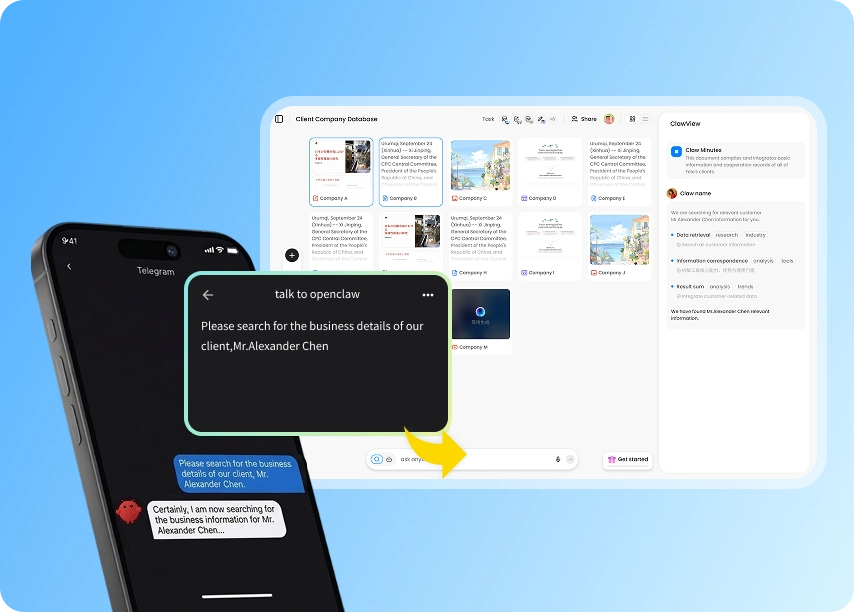
MemClaw solves this. It's a free OpenClaw skill that structures your agent's memory into isolated project workspaces. Install it by sending a single sentence to OpenClaw:
Please install https://github.com/Felo-Inc/memclaw
Setup takes under five minutes with a free Felo account for the API key.
Once installed, create a project for each codebase:
Create a project called client-portal-react
Work through a session. When you're done, MemClaw saves everything the agent learned — key decisions, file structure context, pricing logic, whatever you discussed. Come back tomorrow:
Resume client-portal-react
The agent has full context. No re-explaining. No "what was I doing?" The isolation by project is the key feature — it prevents context from bleeding between my freelance client's React Native app, my personal Python library, and my side-project Rust tool.
Step 4: The Dual-Mini Setup for Heavy Workloads
If you run multiple coding sessions or batch code review, replicate the two-Mac-Mini pattern that went viral. Designate one Mini as the inference server (it runs Ollama with the larger model and stays headless). Use the second for interactive work.
Both machines connect to the same MemClaw workspace via a shared project link. You start a task on the inference Mini, pick it up on your desktop Mini, and the agent context follows you. The setup cost is a one-time ~$800–$1,000 for two refurb units — versus $2,520/year for the subscription.
What the Cost Comparison Actually Looks Like
Cloud agent subscription: $210/month, $2,520 year 1, $5,040 year 2. Mac Mini local + Ollama + Oh My Coder: $0/month, hardware $459 one-time. Two Mac Minis + MemClaw + shared memory: $0/month, hardware ~$900 one-time.
The single Mini pays for itself by month three. The dual setup by month five. After that, every month is $210 saved.
Why Memory Management Makes or Breaks a Local Agent
Most "free AI coding assistant" tutorials stop at ollama pull + pip install. That gets you a model. It doesn't give you a workflow.
A local coding agent without persistent memory is like a contractor who shows up to your site every morning with no memory of yesterday's conversation. You re-explain the floor plan, the material specs, the client's preferences. By the time context is restored, half the morning is gone.
MemClaw's project-isolated memory prevents that. Each codebase holds its own context boundary — decisions for Client A never leak into Client B's workspace. The web dashboard lets me audit everything the agent has retained across all projects. And if a teammate needs access, I share a project link rather than copying chat logs.
This matters because a free assistant that forgets everything between sessions isn't really free — the hidden cost is the time you spend rebuilding context.
Try the Setup Yourself
1. Install Ollama: brew install ollama && ollama serve
2. Pull a model: ollama pull qwen2.5-coder:7b
3. Install Oh My Coder: pip install oh-my-coder
4. Install MemClaw: send "Please install https://github.com/Felo-Inc/memclaw" to OpenClaw
5. Create a project: "Create a project called my-first-agent-workspace"
6. Start coding with a local agent that remembers
Your subscription ends today. Your free AI coding assistant starts now — and it won't send you a bill next month.